
Critical-listening ear training
Train your ears like a mixing engineer.
Practice hearing frequencies, levels, panning, compression and more — in short daily drills on iPhone, iPad and Mac.
Drills for every mixing skill
Every drill is free to try and useful from the first level.
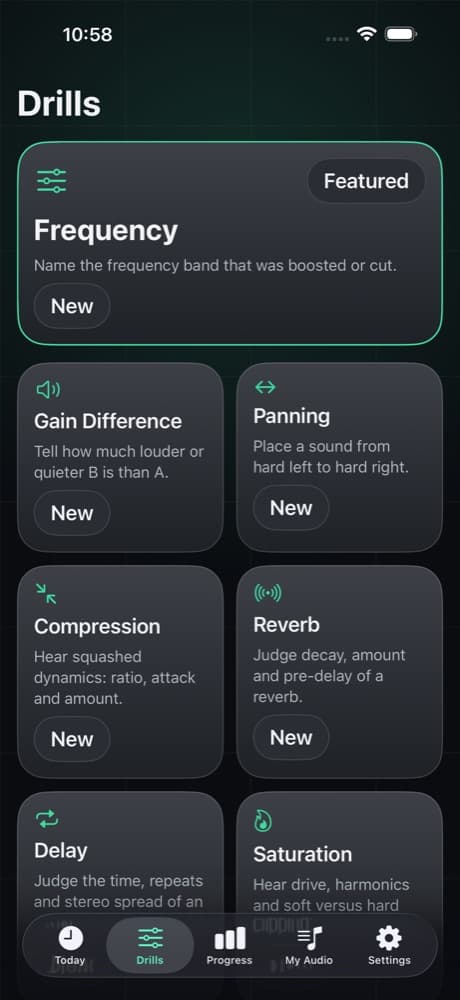
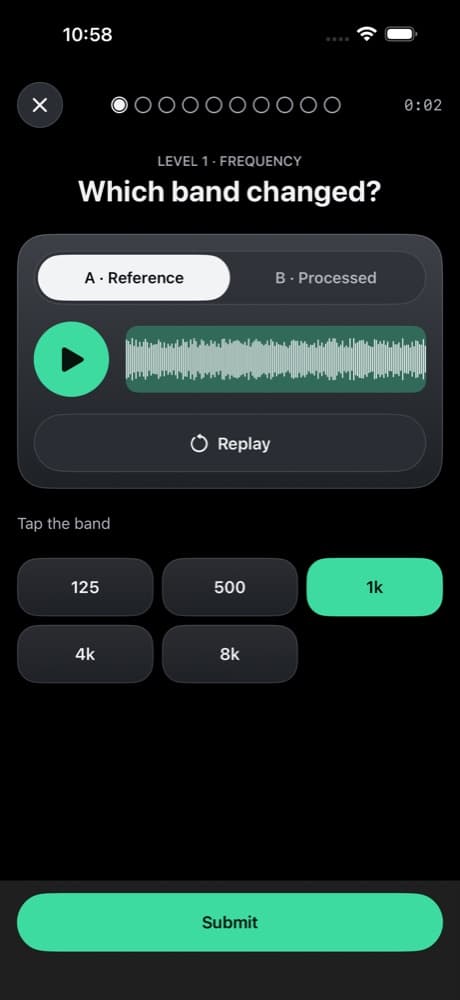
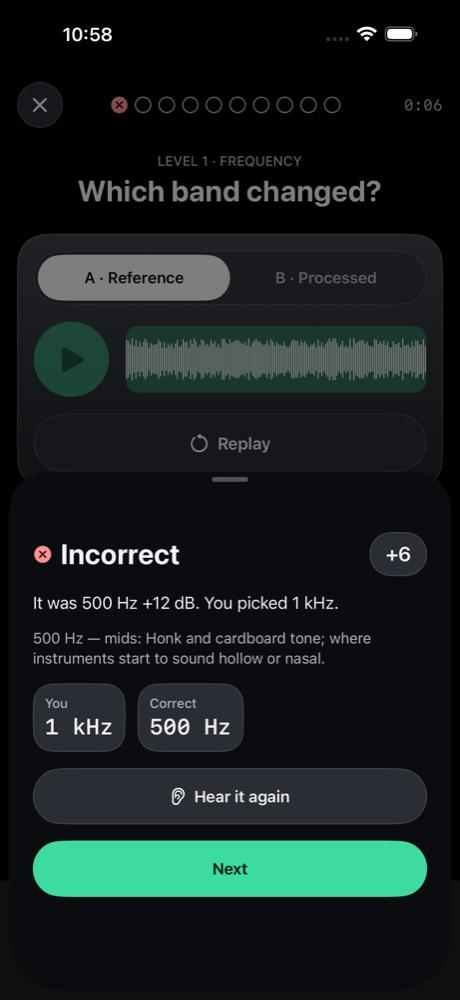
Frequency
Name the frequency band that was boosted or cut.
- What you do
- You hear a sound (noise, a stem or your own track) with one band of EQ boosted or cut, and pick which band it was. Early levels use big boosts on a few octave bands; later levels use third-octave bands with a 3 dB change.
- What it measures
- Frequency resolution: the smallest band and EQ change you can identify, plus boost-versus-cut judgement.
Gain Difference
Tell how much louder or quieter B is than A.
- What you do
- Compare A and B and say whether B is louder or quieter, and by about 1, 3 or 6 dB. Later levels change the level of a single instrument inside a full mix.
- What it measures
- Level sensitivity: the smallest dB difference you can hear, down to 0.5 dB.
Panning
Place a sound from hard left to hard right.
- What you do
- Hear a sound panned somewhere in the stereo field and place it, first in 5 to 9 zones, then with a continuous slider. Later levels pan one instrument inside a mix.
- What it measures
- Stereo placement accuracy: how close your answer is to the real pan position, with partial credit for near misses.
Compression
Hear squashed dynamics: ratio, attack and amount.
- What you do
- Decide whether B is compressed, then identify the ratio (2:1, 4:1, 8:1), the attack time (1, 10, 30 ms) or the gain reduction on the loudest peaks (2, 4, 8 dB).
- What it measures
- Your ear for dynamics: detecting compression and judging its ratio, attack and amount.
Reverb
Judge decay, amount and pre-delay of a reverb.
- What you do
- Listen to a short burst or an instrument with reverb and identify the decay length (0.5 to 3 seconds), how much reverb is mixed in, or the pre-delay before the tail starts (0, 30, 80 ms).
- What it measures
- Space perception: decay time, wet amount and pre-delay.
Delay
Judge the time, repeats and stereo spread of an echo.
- What you do
- Tell whether B has a delay at all, then identify the time between repeats, how many repeats you hear, whether they are mono or ping-pong, and whether they sound clean or dark.
- What it measures
- Echo perception: delay time in milliseconds, repeat count, stereo spread and tone.
Saturation
Hear drive, harmonics and soft versus hard clipping.
- What you do
- Decide whether B is saturated, how hard the peaks are driven (low, medium, high), and whether the distortion is soft (tanh) or a hard clip.
- What it measures
- Harmonic and distortion sensitivity: detecting drive, judging its amount and telling soft from hard clipping.
Built for focused practice
Daily practice
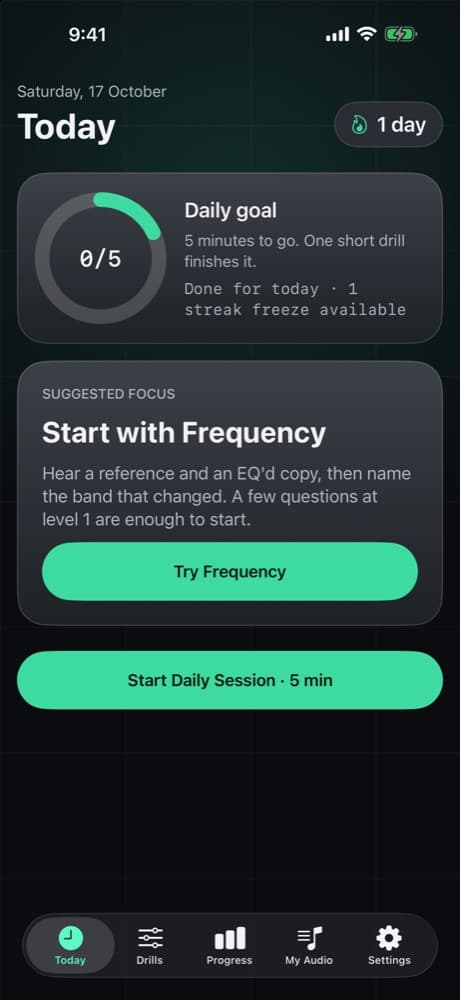
A short, focused session on Today keeps your skills sharp.
Adaptive difficulty
Levels rise as your ear improves, so every session stays challenging.
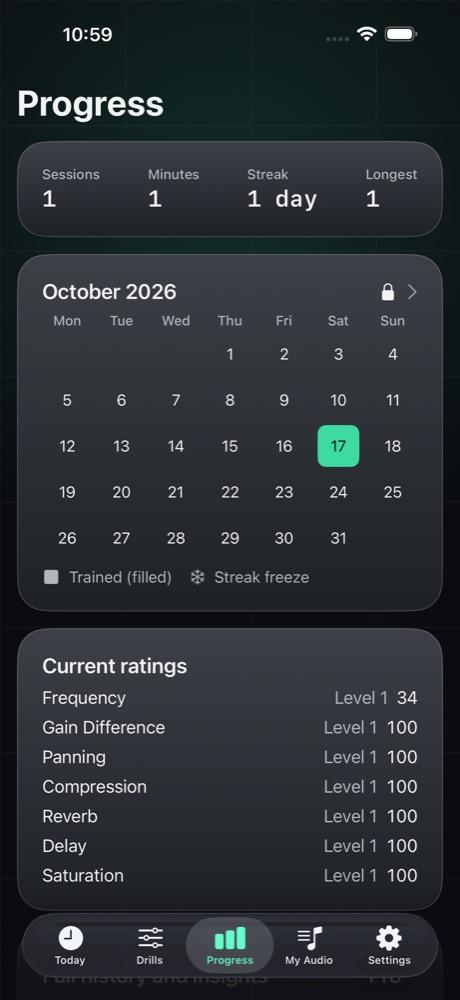
Track your progress
See skill ratings and history grow over time.
Your own audio
Train on your own tracks, processed entirely on your device.
Safe listening
Built-in volume safety and calibration protect your hearing.
iPhone, iPad & Mac
One native app everywhere, with a single purchase.
Free to start. Unlock Pro once.
No subscription. Pro is a one-time purchase that unlocks advanced levels, your own audio and full insights on every device.
Get MixSharp